Your Trusted Orthodontist in Hamilton and Brantford

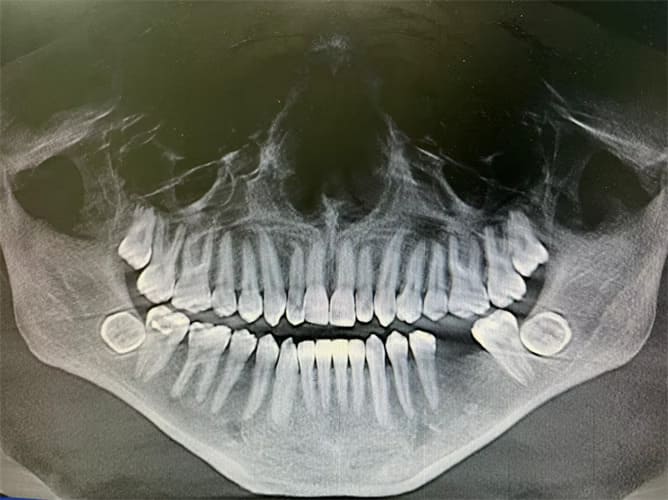
Impacted Teeth: When a Tooth Gets “Stuck” in the Jawbone
An impacted tooth is one that fails to erupt (come through the gums) at the expected time because it’s partially or completely trapped in the jawbone or beneath the gum tissue. In simple terms, the tooth is stuck and unable to move into its correct position naturally.
Why Do Teeth Become Impacted?
- Insufficient space in the jaw for the tooth to emerge.
- Abnormal eruption angle or direction of the tooth.
- Obstructions, such as adjacent teeth, retained baby teeth, or extra (supernumerary) teeth.
- Dense bone or gum tissue covering the tooth.
- Genetic or developmental factors that interfere with normal eruption.
Impaction most often affects canine teeth (eye teeth) and wisdom teeth, but it can occur with any tooth.
Why Impacted Teeth Need Attention
- Damage to nearby teeth, including root resorption.
- Cysts or lesions forming around the trapped tooth.
- Infection or gum inflammation near the area.
- Shifting or crowding of surrounding teeth.
- Bite misalignment and changes in facial symmetry.
- More complex treatment later if left unmonitored.
How Orthodontists Help
At Smiles in Motion Orthodontics, we use digital X-rays and 3D imaging to precisely locate impacted teeth and plan the best treatment strategy. Depending on the case, treatment may include:
- Creating space orthodontically using braces or aligners.
- Guided eruption with gentle orthodontic traction after surgical exposure.
- Collaboration with your oral surgeon for safe uncovering and attachment of an orthodontic bracket.
- Monitoring in younger patients to catch early signs before eruption becomes blocked.
Benefits of Early Detection
- Prevents damage to adjacent teeth.
- Reduces need for surgery or tooth extraction later.
- Improves tooth alignment and overall bite balance.
- Enhances smile appearance and facial symmetry.
Expert Care for Impacted Teeth
At Smiles in Motion Orthodontics, we specialize in diagnosing and treating impacted teeth using the latest technology and evidence-based techniques. With early intervention, we can help “unstick” the tooth, guide it safely into place, and restore a healthy, confident smile.